
Author: Hannah Catalino Liberty Horsemanship
I have spent the last 13 years traveling the world learning compassionate and effective training techniques that help transform countless untouched wild horses, burros, and mules into willing partners. My specialization is in liberty training, using choice-based principles at the foundation of every equine’s education, regardless of whether they are gentled already or completely wild and unhandled.
Learning From the Greatest Teachers: The Horses
Although I have had many amazing human mentors, the most notable are the horses themselves. I’ve studied many different wild horses across the globe, learning about their unique environmental and cultural challenges to understand their behavior better. In the training realm, I have had the chance to work with hundreds of students and horses from many different countries and backgrounds, although the wild ones tend to be where my heart is most.


As a competitor, I have earned three Championship titles and seven Reserve Championships with my mustang and burros at Mustang Challenges. Internationally I have been in Europe as a guest presenter, competitor, and judge for the prestigious Germany Mustang Makeover for many years. In the Southern Hemisphere, I have spent time as a clinician, competitor, and judge at New Zealand’s Equifest and as a clinician and judge for Equitana Australia for the Brumby Challenge.
Beyond my professional achievements, I embarked on a personal journey covering 750 continuous miles across diverse American terrain with two of my personal mustangs and one burro, riding treeless, bitless, and barefoot to deepen the connection with my herd further.

Shifting Toward Whole-Horse Wellness
Having spent many years in the problem horse world and developing a strong understanding of behavioral issues, I now approach my work with horses with more mindfulness towards their mind, body, and spirit. Previously, as a trainer, my attention focused more on the horse’s mental learning of new behaviors and how to break problems down into even smaller asks to help them learn how to work through various situations. However, even after growing problem-solving skills by studying with many leaders in the industry, I would keep running into roadblocks with some horses. The horse’s physical well-being is incredibly important to their ability to learn. If they are in pain or not feeling, well or lacking something, this can really affect training. This is where I take my horse’s nutrition very seriously and love Horseshine and Nibblers, which are so good for my horses inside and out.


Now, if I have their mental and physical needs met and there is still something off, I try to understand better what the horse might be struggling with emotionally. This can look like working with someone to release trapped emotions, energy cleanses, and sometimes consulting with an animal communicator. By broadening my approach and really focusing on the whole horse’s well-being from many angles, I’ve noticed the combination to be game-changing.
Meeting Wild Horses Where They Are
When a new wild mustang arrives, the first thing I do, before training begins, is address their nutritional needs. Many do not know that there is more to eat in the world besides grass and hay, so they quite literally have to be taught how to eat from buckets. I try to stay away from grains with my horses and it’s easier for the wild ones to understand that hay pellets are edible. If there are too many flavors it can completely turn some horses off. To avoid choke, I always thoroughly soak my hay pellets. Even still the texture can be challenging for some, so I will mix really leafy alfalfa in the soaked pellets to help them understand that they can eat it.


Nutrition for Lasting Change
Once my wild ones are consistently eating the soaked pellets, then I gradually start adding new things to their diet, depending on their needs. It is essential only to introduce one supplement at a time, in case they don’t like the taste, it doesn’t prevent them from eating the others. Typically, I like to begin with deworming them with a pelleted dewormer. I believe ulcers in the wild horse world, especially with the mustangs, are huge contributors to mustangs presenting behavioral issues where they can’t seem to make steps forward. Through feed, I’ve found ways to support their gut health, allowing them to progress through training more easily. And then I start introducing Horseshine, which always amazes me at how it only takes a few days for the horses to gleam.

Incorporating Positive Reinforcement
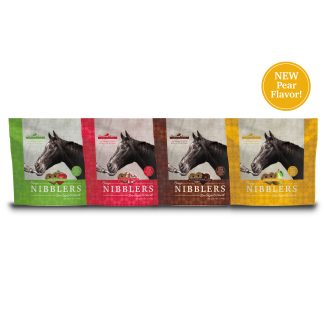
As my horses advance, I do add in positive reinforcement into their training. I think in the right hands it’s such an incredible tool. My favorite treat for my horses are Omega Nibbers. They are not only easy to break for smaller portions for training, but my horses love them, and the biggest bonus is knowing that they are low sugar and healthy snacks for my horses.
A Transformation to Remember: Scooby Snack
One of my favorite transformations was with Omega Field’s Scooby Snack, a yearling mustang I picked up for a mustang challenge. He was infested with worms and just overall did not look as healthy as he could. In just a matter of a few short months, he transformed from quite literally a gangly, ugly duckling into a stunning young horse. Scooby went on to perform beautifully, placing Reserve Champion behind another mustang I trained for the same competition.
It brings me so much joy to not only see my wild horses’ fear turn to trust, but also witness them feeling better and more confident with all the diligent care that goes into starting their new life with humans from day one.




 Dog Collar Fancy
 SaddleRight.com
 WiredWorks